If you’ve received a call from a number starting with 520, or you’re planning a move to the American Southwest, you might be wondering: Where exactly is this?
What is Area Code 520?
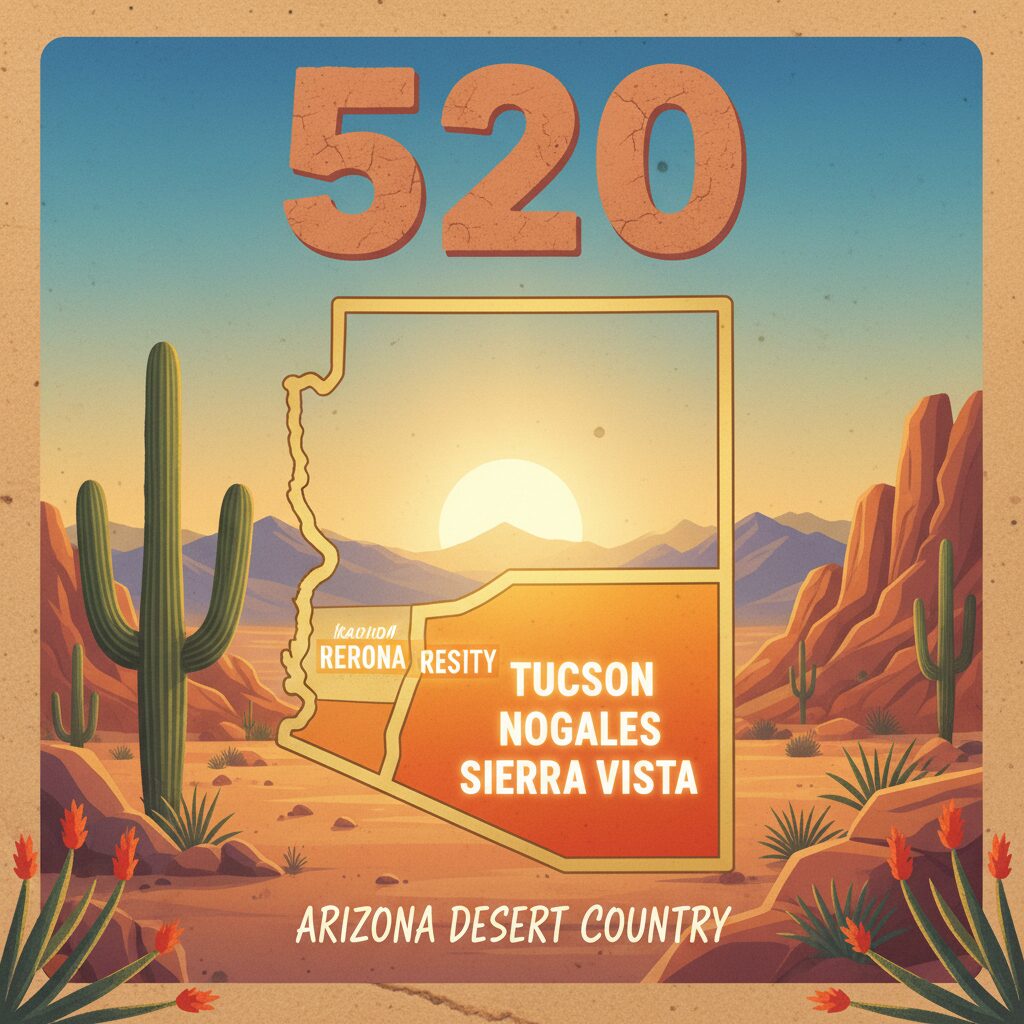
Area code 520 serves the state of Arizona, specifically the southern portion of the state. It encompasses a diverse landscape ranging from the Sonoran Desert’s cactus-filled plains to the “sky island” mountains that dot the region.
Most notably, 520 is the area code for Tucson, Arizona’s second-largest city.
However, its reach extends far beyond the Tucson city limits, covering several counties and serving as a lifeline for rural communities, border towns, and military installations like Fort Huachuca.
A Brief History of Area Code 520
To understand the 520 area code, you have to look back at the telecommunications history of Arizona.
1947 – The Beginning
When the North American Numbering Plan was first established, the entire state of Arizona was served by a single area code: 602.
1995 – The Split
By the mid-90s, Arizona’s population was exploding. The demand for fax machines, pagers, and cell phones meant 602 was running out of numbers.
On March 19, 1995, area code 520 was created. It was the second area code in the state, designed to serve everything outside of the immediate Phoenix metropolitan area.
2001 – The Second Split
The growth didn’t stop. In 2001, the northern and western parts of Arizona (including Flagstaff and Yuma) were split off to form the 928 area code.
This left 520 to cover the southeastern portion of the state, which is the configuration that remains today.
Geographical Coverage: Cities and Counties
The 520 area code covers a vast stretch of land, primarily serving Pima, Santa Cruz, Cochise, and parts of Pinal counties. Below is a breakdown of the major locations you can reach with this prefix.
Major Cities in 520
While Tucson is the hub, several other significant towns and cities utilize this area code:
| City | County | Known For |
| Tucson | Pima | University of Arizona, Saguaro National Park |
| Sierra Vista | Cochise | Fort Huachuca, bird watching |
| Casa Grande | Pinal | Mining history, halfway point to Phoenix |
| Nogales | Santa Cruz | Key border city with Mexico |
| Marana | Pima | Luxury resorts, golf, agriculture |
| Oro Valley | Pima | High-tech industry, scenic views |
| Bisbee | Cochise | Historic copper mining, arts scene |
| Tombstone | Cochise | “The Town Too Tough to Die” (Wild West history) |
Counties Covered
- Pima County: The most populous county in the area code.
- Cochise County: Home to historic western towns.
- Santa Cruz County: Located on the border with Mexico.
- Pinal County: Partially covered (shared with area code 520 and 480/602).
Demographics and Culture of Southern Arizona
The region covered by area code 520 is distinct from the rest of the state. It is a blend of Native American heritage, Mexican culture, and Wild West history.
Tucson is the cultural anchor. Known for being the first UNESCO City of Gastronomy in the United States, it offers an incredible food scene featuring Sonoran-style Mexican cuisine. The area is also famous for:
- Saguaro National Park: Home to the giant cacti that define the American West.
- Astronomy: With clear dark skies and high elevations, the 520 area is a global hub for observatories and astronomy.
- The Gem and Mineral Show: The largest event of its kind in the world, taking over Tucson every February.
Time Zone and Daylight Saving Time
If you are calling the 520 area code from out of state, timing is everything.
- Time Zone: Mountain Standard Time (MST).
- Daylight Saving Time (DST): Arizona is unique because it does not observe Daylight Saving Time.
This means that for half the year, Arizona is on the same time as the Pacific Time Zone (Los Angeles), and for the other half, it aligns with the Mountain Time Zone (Denver).
When planning a call, always check the current time in Arizona, as it does not “spring forward” or “fall back” like the rest of the country.
How to Dial Area Code 520
Dialing requirements can change based on where you are calling from. Here is a quick guide:
- Calling from a Landline within 520: In some cases, you can still dial the 7-digit number. However, with the introduction of the 988 suicide prevention hotline, ten-digit dialing (Area Code + Phone Number) has become the standard in many areas.
- Calling from Outside 520: You must dial 1-520-XXX-XXXX.
- Calling from Mobile: Always dial the full 10-digit number (520-XXX-XXXX).
Is Area Code 520 a Scam?
This is a common question. Because 520 is not as instantly recognizable as 212 (NY) or 310 (LA), people often view it with suspicion.
The Verdict: The area code itself is legitimate. It belongs to residents and businesses in Southern Arizona.
However, like any area code, scammers can “spoof” numbers to make it look like they are calling from a local line.
Who Might Be Calling?
- Legitimate: University of Arizona administrative offices, medical centers in Tucson (like Banner Health), resorts, or local family members.
- Potential Scams: Robocalls regarding “car warranties,” “IRS debts,” or “border patrol” scams often target this region due to its proximity to the border.
How to Handle Unknown Calls Safely
- Don’t Answer: If you don’t recognize the number, let it go to voicemail. A real caller will leave a message.
- Do Not Press Buttons: If you answer and a recording asks you to press a button to “speak to an agent” or “be removed from the list,” hang up. This verifies your number is active.
- Use a Reverse Lookup: If you are unsure, type the number into a search engine or use a reverse phone lookup service to identify the carrier and location.
Common Misconceptions
Misconception: 520 covers Phoenix.
Fact: No. Phoenix uses area codes 602, 480, and 623. 520 begins where the Phoenix metro area ends.
Misconception: It is an international code.
Fact: 520 is a US domestic code. However, it borders Mexico (country code +52), which can sometimes cause confusion for those unfamiliar with international dialing codes.
Frequently Asked Questions
What state is area code 520?
Area code 520 serves the state of Arizona, covering the southern region including Tucson.
What time is it in area code 520?
The area operates on Mountain Standard Time (MST). Arizona does not observe Daylight Saving Time, so the time remains constant year-round.
Is 520 a toll-free number?
No, 520 is not a toll-free code. It is a geographic area code. Long-distance charges may apply depending on your phone plan.
Can I get a 520 phone number if I don’t live in Arizona?
Yes. Many VoIP (Voice over IP) providers allow you to purchase numbers with specific area codes regardless of your physical location, which is great for businesses targeting Tucson customers.
What major cities are in the 520 area code?
Tucson is the largest city. Others include Sierra Vista, Casa Grande, Nogales, Marana, and Bisbee.
When was area code 520 established?
It was established on March 19, 1995, splitting off from the original 602 area code.
Does area code 520 cover the Grand Canyon?
No. The Grand Canyon is located in Northern Arizona, which is served by the 928 area code.
What counties are served by 520?
It primarily serves Pima, Cochise, and Santa Cruz counties, along with portions of Pinal and Maricopa counties.
Why am I getting spam calls from 520?
If you live in the area, scammers often use “neighbor spoofing” to make calls look local so you are more likely to answer. If you don’t live there, it is likely a random robocall.
How do I dial Mexico from area code 520?
To call Mexico from a landline in the 520 area, you typically dial 011 (exit code) + 52 (country code) + the local number.
Explore Southern Arizona
Whether you are dialing in for business or planning a visit to the “Old Pueblo,” knowing the lay of the land helps you stay connected.
Need to verify a specific 520 number? Use a trusted reverse phone lookup tool today to see exactly who is calling.
Daniel Brooks is a telecommunications and digital information writer with 8+ years of experience researching area codes, phone number systems, and call safety topics. He focuses on clear, accurate, and user-friendly explanations based on reliable public data sources.