If you have recently received a call from a number starting with 571, or if you are planning a move to the Washington D.C. metro area, you are dealing with one of the most economically vital regions in the United States.
Where is Area Code 571 Located?
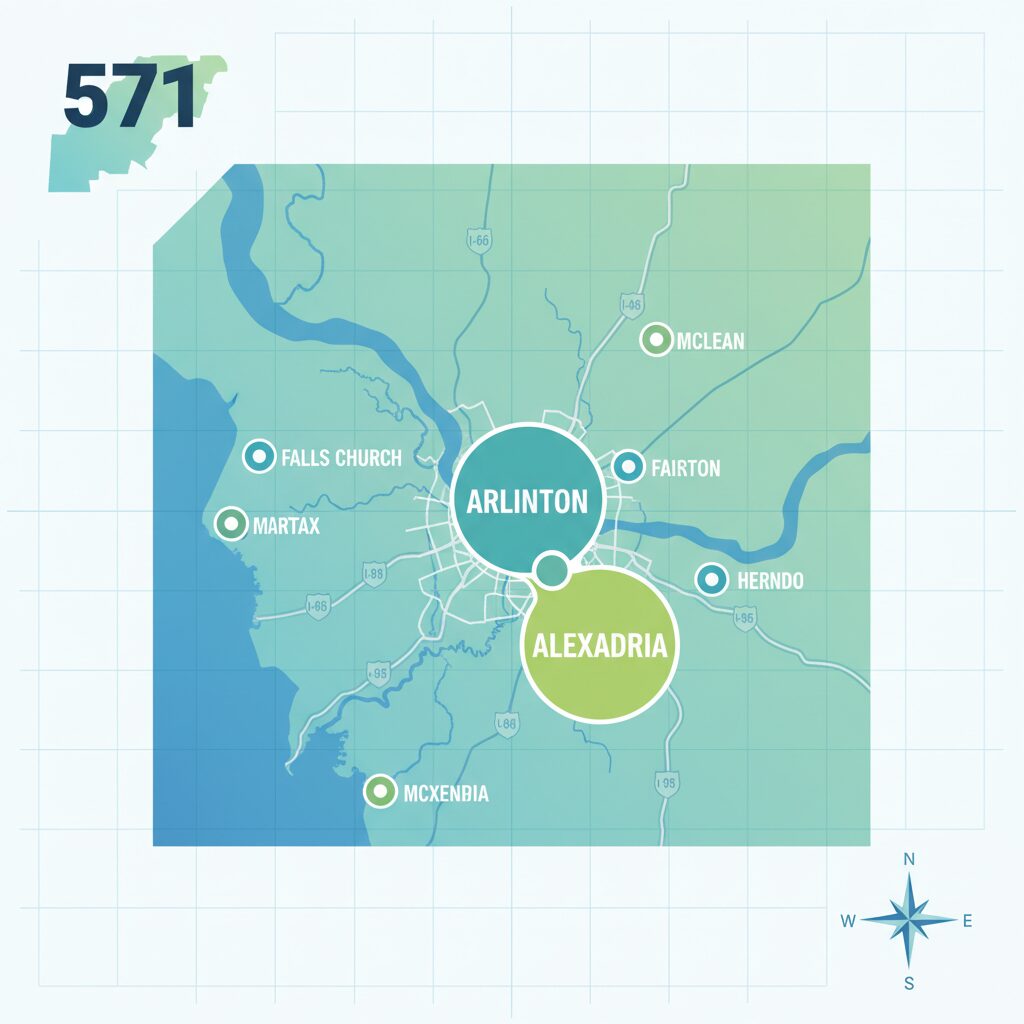
Area code 571 serves the northeastern part of Virginia. This region, commonly known as “NoVA” (Northern Virginia), sits directly adjacent to Washington D.C. and includes some of the most densely populated suburbs in the country.
Because 571 is an “overlay” code, it covers the exact same geographic territory as the older 703 area code. If you are in this region, your neighbor might have a 703 number while you have a 571 number.
Key Counties Served
- Arlington County
- Fairfax County
- Loudoun County
- Prince William County
- Stafford County (partial coverage)
The History of Area Code 703
To understand 571, we must look at its predecessor, area code 703.
When the North American Numbering Plan was established in 1947, area code 703 was one of the original codes created. At that time, it served the entire Commonwealth of Virginia.
You could call from the beaches of Norfolk to the mountains of Roanoke using the same area code.
As Virginia’s population grew, this single code became insufficient.
- 1973 Split: The eastern portion of the state (including Richmond and Virginia Beach) was split off to create area code 804.
- 1995 Split: The western and southwestern portions of the state were split off to form area code 540.
By the late 1990s, 703 was restricted solely to Northern Virginia. However, the region’s explosive growth was far from over.
Why Was Area Code 571 Created?
By the turn of the millennium, Northern Virginia was experiencing a massive technology boom.
It wasn’t just new residents that needed phone numbers; the sudden proliferation of fax machines, pagers, dial-up internet modems, and the early adoption of cell phones drained the available pool of 703 numbers.
To solve this “number exhaustion,” the North American Numbering Plan Administration introduced area code 571 on March 1, 2000.
Unlike previous changes, this was not a geographic split. Instead, it was implemented as an overlay. This meant that 571 was added on top of the existing 703 map.
Existing residents kept their 703 numbers, while new devices and residents were assigned 571 numbers.
Geographic Coverage and Cities Served
The 571 area code covers independent cities and towns that serve as the economic engine of Virginia. Below is a breakdown of major locations using this prefix.
| County | Major Cities & Communities |
| Arlington | Arlington, Crystal City, Rosslyn |
| Fairfax | Fairfax, Reston, Tysons, Herndon, Centreville, McLean, Annandale, Burke |
| Loudoun | Leesburg, Ashburn, Sterling, Dulles |
| Prince William | Manassas, Woodbridge, Dale City, Gainesville |
| Independent Cities | Alexandria, Falls Church, Manassas Park |
How to Dial in the 571 Region
Before the year 2000, residents in Northern Virginia could dial a local neighbor using only seven digits (e.g., 555-0199). The introduction of the 571 overlay changed this permanently.
Because two different area codes now serve the same street, 10-digit dialing is mandatory.
- Local Calls: You must dial the area code + the phone number (e.g., 571-555-0123 or 703-555-0123).
- Long Distance: You generally dial 1 + area code + phone number.
If you attempt to dial just seven digits in this region, your call will not connect, and you will likely hear a recording instructing you to hang up and dial again using the full number.
Major Providers and Network Coverage
Given the density of Northern Virginia, all major US carriers provide coverage in the 571 region, including AT&T, T-Mobile, and Sprint.
However, historical data indicates that Verizon serves over 85% of the telephone numbers in the 703 and 571 area codes. This is largely due to the legacy of Bell Atlantic (a Verizon predecessor) holding the local monopoly in the region for decades.
While mobile competition is fierce, Verizon remains the dominant holder of landline and business numbers in the area.
What Time Zone is Area Code 571?
Area code 571 is located in the Eastern Time Zone.
- Standard Time: Eastern Standard Time (EST), which is UTC-5.
- Daylight Saving Time: Eastern Daylight Time (EDT), which is UTC-4.
This aligns with major east coast cities like New York, Philadelphia, and Miami.
Is Area Code 571 a Scam?
This is a common concern. Because 571 is a newer overlay code, some people mistake it for a toll-free number or a foreign code.
The Verdict: Area code 571 is a legitimate, geographic area code for Northern Virginia.
It is used by millions of residents, local businesses, and significant government entities, including the U.S. Patent and Trademark Office and the Transportation Security Administration (TSA).
Who Might Be Calling From This Area Code?
- Legitimate Businesses: Northern Virginia is a hub for tech startups, defense contractors, and legal firms.
- Government Agencies: Many federal agencies headquartered in NoVA use 571 numbers.
- Residents: Anyone who moved to the area or got a new cell phone after the year 2000 likely has a 571 number.
How to Handle Unknown Calls Safely?
Despite the code being legitimate, scammers often use “neighbor spoofing.” They rig their caller ID to show a local 571 number, hoping you will pick up because it looks familiar.
- Don’t Answer: If you do not recognize the number, let it go to voicemail. A legitimate caller will leave a message.
- Reverse Lookup: Use a reputable reverse phone lookup service to check the number’s origin.
- Block Spam: Use your smartphone’s built-in spam blocking features or download a third-party app to filter robocalls.
- Verify Identity: If someone claims to be from a government agency (like the IRS or TSA) calling from a 571 number, hang up and call the agency back on their official, publicly listed number.
Frequently Asked Questions
What is the difference between area code 703 and 571?
There is no geographic difference. They cover the exact same area. The only difference is age: 703 numbers are generally older (pre-2000), while 571 numbers are newer.
Is 571 a toll-free number?
No. 571 is a standard local area code. If you call a 571 number from outside the local calling area, you may be charged for long-distance, depending on your phone plan.
Can I keep my 571 number if I move?
Yes, thanks to Local Number Portability (LNP) rules, you can typically keep your 571 number even if you move out of Northern Virginia or switch service providers.
Why did I get a text message from a 571 number?
It is likely a standard SMS from a mobile phone in Northern Virginia. However, be cautious of phishing texts (smishing) asking for personal data, regardless of the area code.
Are there other area codes in Virginia?
Yes. Virginia is served by several codes, including 804 (Richmond), 757 (Virginia Beach/Norfolk), 540 (Western/Southwestern VA), 434 (Charlottesville/Lynchburg), and 276 (Southwest corner).
When was area code 571 established?
It was put into service on March 1, 2000.
Do I need to dial 1 before 571 for local calls?
Usually, no. For local calls within the NoVA region, you just dial the 10 digits (571-555-0123). Dialing “1” is typically reserved for long-distance calls, though modern cell phones often handle this automatically.
Is 571 part of Washington D.C.?
No. Washington D.C. uses area code 202 (and the new overlay 771). However, 571 covers the suburbs immediately surrounding D.C.
What are the major industries in the 571 area?
The region is dominated by the federal government, defense contracting, cybersecurity, data centers, and telecommunications.
How do I get a 571 phone number?
If you establish a new landline or mobile service within the geographic region of Northern Virginia, you can request a 571 number. VoIP providers also sell 571 numbers for businesses wishing to establish a local presence in the area.
Stay Connected Safely
Do you need to verify a specific 571 number? Use a trusted reverse phone lookup tool today to ensure the caller is who they claim to be.

Daniel Brooks is a telecommunications and digital information writer with 8+ years of experience researching area codes, phone number systems, and call safety topics. He focuses on clear, accurate, and user-friendly explanations based on reliable public data sources.