If you have received a call from area code 240, or if you are looking to establish a local presence in the Maryland area, you might have questions. Is this a legitimate number? Where exactly is the caller located?
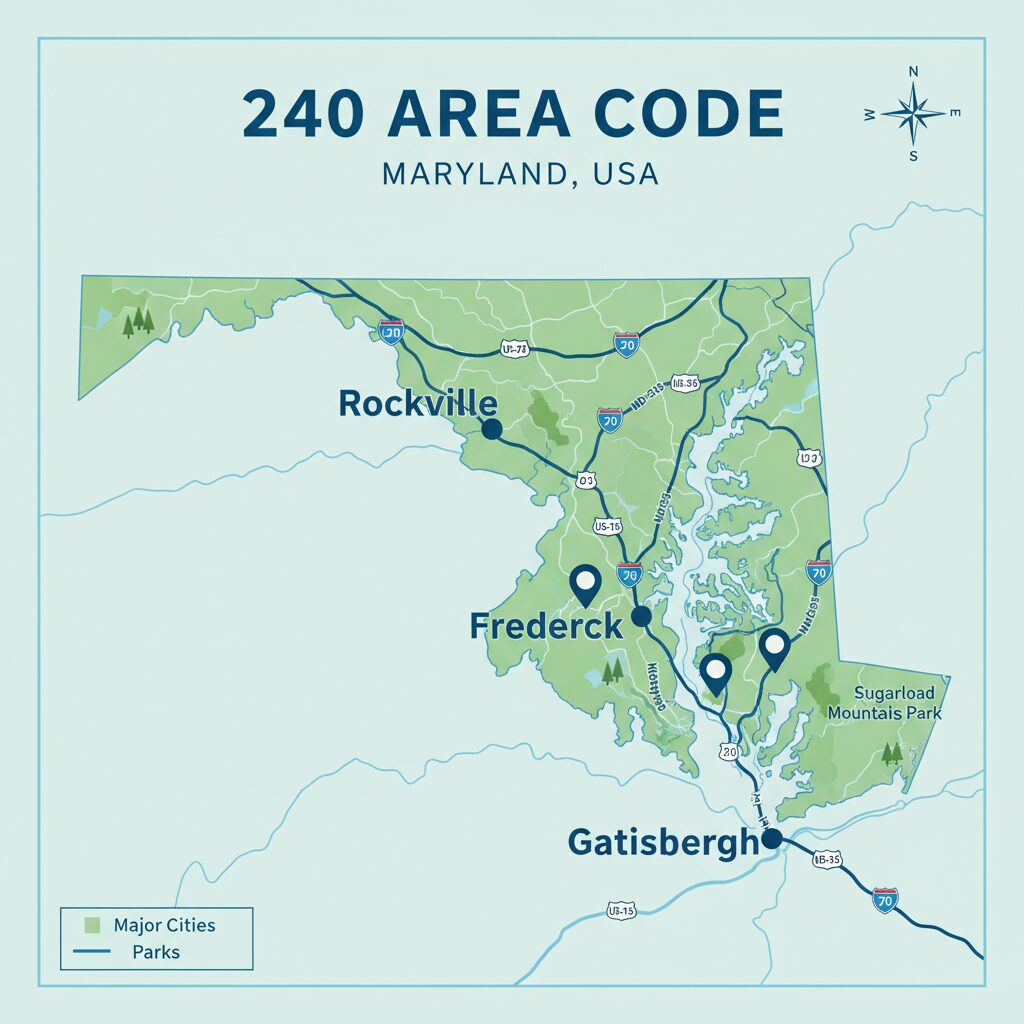
Area code 240 serves the western part of Maryland, covering the heavily populated suburbs of Washington D.C., as well as rural areas stretching toward the mountains.
It is home to millions of residents, thriving technology corridors, and major government institutions.
The History of Area Code 240
To understand area code 240, you have to look at the history of Maryland’s telecommunications. Originally, the entire state was served by a single code: 301.
As the population grew, specifically in the Baltimore-Washington corridor, the state needed more numbers.
Here is the timeline of how area code 240 came to be:
1947
Area code 301 is established to serve all of Maryland.
1991
The state splits. The Baltimore area and Eastern Shore switch to 410, leaving Western Maryland and the D.C. suburbs with 301.
1997
The 240 area code is introduced. However, instead of splitting the region again geographically, it was added as an overlay.
This meant 240 and 301 served the exact same geographic area simultaneously.
2023
With both 301 and 240 running out of combinations, a third overlay, area code 227, was introduced to the same region.
Note: Because 240 was introduced as an overlay in 1997, it required Maryland residents to switch to 10-digit dialing (area code + phone number) for all local calls, a significant change at the time.
Cities and Regions Covered by Area Code 240
Area code 240 covers a diverse mix of landscapes, from the bustling urban centers bordering Washington D.C. to the quiet, scenic mountains of Western Maryland.
It primarily serves the following counties:
- Montgomery County (Bethesda, Silver Spring, Rockville)
- Prince George’s County (Bowie, Greenbelt, National Harbor)
- Frederick County (Frederick)
- Washington County (Hagerstown)
- Charles County (Waldorf)
- St. Mary’s County (Lexington Park)
- Allegany County (Cumberland)
- Garrett County (Deep Creek Lake)
Major Cities in Area Code 240
Here is a breakdown of the key cities served by this area code:
| City | County | Known For |
| Silver Spring | Montgomery | Arts, entertainment, and proximity to D.C. |
| Germantown | Montgomery | One of Maryland’s most populous regions. |
| Bethesda | Montgomery | Home to the National Institutes of Health (NIH). |
| Rockville | Montgomery | Technology corridor and bio-health businesses. |
| Frederick | Frederick | Historic downtown and Civil War history. |
| Bowie | Prince George’s | Major residential hub and retail center. |
| Hagerstown | Washington | Transportation and commerce hub (“Hub City”). |
| Waldorf | Charles | Rapidly growing commercial center in Southern MD. |
The Overlay System: 301, 240, and 227
It is important to understand that area code 240 does not have a unique geographic boundary separate from area code 301. They are essentially twins.
If your next-door neighbor has a 301 number, you might have a 240 number, and a new business across the street might get a 227 number. They all function in the exact same territory.
- 301: The legacy code (often held by long-time residents and established businesses).
- 240: The “newer” code (though now over 25 years old).
- 227: The newest addition (assigned to new lines starting June 2023).
Time Zone and Usage Information
Maryland is located on the East Coast of the United States. Therefore, all numbers within the 240 area code utilize the Eastern Time Zone.
- Standard Time: Eastern Standard Time (EST) — UTC-5
- Daylight Saving Time: Eastern Daylight Time (EDT) — UTC-4
If you are calling a business in Rockville or Frederick from California (Pacific Time), remember that they are three hours ahead of you.
Why a Local Area Code Matters for Businesses
If you are running a business that targets customers in the D.C. metro area or Western Maryland, having a 240 phone number is a strategic asset.
Local Trust
Residents are more likely to answer a call from a familiar area code than a toll-free (800) number or an out-of-state code.
Regional Prestige
The 240 area code is associated with affluent areas like Montgomery County and tech hubs like the I-270 corridor.
Customer Convenience
It signals to your clients that you are part of their community, not a distant corporation.
Is Area Code 240 a Scam?
Area code 240 is a legitimate NANPA (North American Numbering Plan Administration) code. However, like any common US area code, it is frequently used by scammers for “neighbor spoofing.”
Neighbor spoofing is when a scammer fakes the caller ID to match your area code (and often the first three digits of your phone number) to trick you into thinking a local neighbor or business is calling.
Who Might Be Calling From This Area Code?
Because the 240 region includes major government and medical facilities, legitimate calls often come from:
- Government Agencies: Many federal employees live or work in this zone.
- Medical Providers: NIH, Walter Reed, and major regional hospitals are in the 240/301 zone.
- Debt Collectors: Several collection agencies operate out of the D.C. suburbs.
- Political Campaigns: Due to the proximity to D.C., political surveying is common here.
How to Handle Unknown Calls Safely
If you receive an unexpected call from a 240 number:
- Do Not Answer Immediate Unknowns: Let it go to voicemail. If it is important, they will leave a message.
- Verify the Number: Type the number into a search engine. Legitimate businesses usually appear in the results.
- Don’t Trust Caller ID: Remember that scammers can easily fake the number displayed on your screen.
- Never Share Personal Info: No legitimate utility company or government agency will call you demanding immediate payment via gift card or wire transfer.
Frequently Asked Questions
Is area code 240 toll-free?
No. Area code 240 is a geographic landline and mobile code for Maryland. It is not a toll-free code like 800, 888, or 877. Long-distance charges may apply depending on your phone plan.
What is the newest area code in Maryland?
Area code 227 is the newest code. It was activated in June 2023 to support the regions already covered by 301 and 240.
Do I need to dial 1 before 240?
For landlines, it depends on your specific carrier and plan, but generally, you dial the 10-digit number (240-xxx-xxxx). On mobile phones, you simply dial the 10-digit number.
Which area code is better for business: 301 or 240?
Neither is technically “better,” but 301 is often viewed as a “legacy” number implying a long-standing presence, while 240 is standard for modern businesses. Both are widely recognized and trusted in the region.
Can I keep my 240 number if I move out of Maryland?
Yes. Thanks to number portability laws (LNP), you can generally keep your mobile number or VoIP number even if you move to a different state.
What happens if I dial 7 digits in the 240 area?
The call will not connect. Maryland has required 10-digit dialing (Area Code + Number) since 1997 due to the overlay system.
Does area code 240 cover Baltimore?
No. Baltimore City and Baltimore County are primarily served by area codes 410, 443, and 667. 240 covers the areas west and south of Baltimore.
Are 240 numbers hard to get?
They are becoming scarcer, which is why the 227 area code was added. However, you can still obtain 240 numbers through various VoIP providers and mobile carriers.
Is 240 a mobile or landline code?
It is used for both. When it was introduced in 1997, it was heavily assigned to new mobile phones and pagers, but today it is used for landlines, fax machines, and VoIP systems alike.
How do I block spam calls from area code 240?
Most smartphones allow you to block individual numbers in your call log settings. You can also register your number on the National Do Not Call Registry or use third-party spam blocking apps.
Conclusion
Looking to establish a local presence in Maryland?
Don’t rely on a generic number. Secure a trusted local number today to build credibility with your customers.
Daniel Brooks is a telecommunications and digital information writer with 8+ years of experience researching area codes, phone number systems, and call safety topics. He focuses on clear, accurate, and user-friendly explanations based on reliable public data sources.